
Act. Observe. Capture. Develop. Print.
Sleepless, I lie awake trying to articulate the place photography occupies in my life. Its presence extends well beyond the hours spent with a camera. Images return to me. Shapes, gestures, and arrangements of light linger in my mind, asking for something I have yet to understand.
Increasingly, I sense a visual language taking form in the work. I recognize it in the subjects that hold my attention, in what I leave outside the frame, and in the photographs I choose to print.
I have begun to think of this practice through five principles. Each asks something different of me. Together, they describe the passage from an impulse to go looking to a finished object I can hold.
Act. Observe. Capture. Develop. Print.
At the San Francisco Museum of Modern Art, I wandered with a camera in hand, immersing myself in the visual language of others. From an upstairs gallery, I looked down and found the staircase. At first it was empty, an arrangement of lines, planes, and warm wood. Then people entered the frame, and the photograph began to take shape.
The first is simply to act.
I must put myself where a photograph might become possible. Leave the house. Walk the road. Carry the camera. Make room in the day for something whose value I cannot know beforehand.
This begins as planned intentionality. I decide to go, even when the light seems unremarkable, or my attention is elsewhere. With repetition, the decision becomes a habit. Photography begins to shape how I move through the world.
There is no assurance that I will return with an image. The act is an expression of willingness.
Once there, I must observe.
Looking comes easily. Being present requires more of me. I can pass through a place and register its contents without giving any of them my attention.
To observe, I have to stay long enough for the first impression to loosen its hold. A tree becomes an arrangement of vertical lines. A window becomes a field of light. A figure passing through the scene changes the balance of everything around it.
The subject may have been there all along. What changes is my capacity to receive it.
This asks for my whole attention: mind, body, spirit. Sometimes it also asks me to wait.
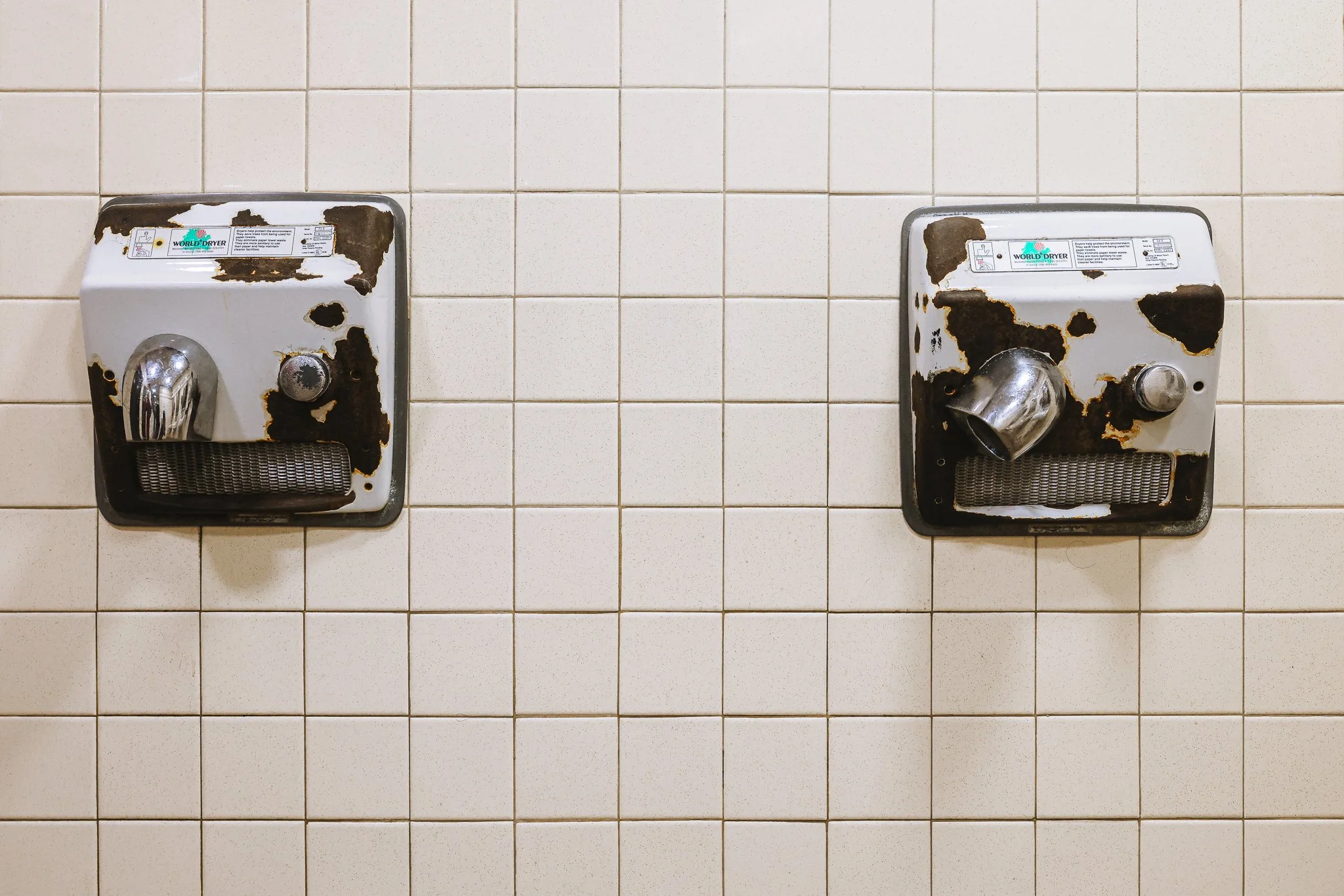
While camping at a Washington state park, I noticed these two hand dryers. Rust and chipped paint had given each a different pattern of wear. Mounted side by side, they invited comparison. I wondered about the decision to install two, and the years of use that had gradually made them unlike each other.
Only then comes the capture.
The viewfinder gives my attention a boundary. Within it, I begin making decisions about relationships, distance, and proportion. A small movement changes what the image holds. An edge cuts through a shape. A distraction disappears. Two unrelated things begin speaking to each other.
Exclusion carries consequence. Everything left outside the frame helps determine the meaning of what remains within it.
The shutter records that arrangement for a fraction of a second. It also records a choice.
Then I must allow time to pass.
At the moment of capture, excitement can make an image feel more resolved than it is. I remember the air, the walk, the difficulty of reaching a place. Those memories accompany the photograph when I first look at it.
A viewer will arrive without them.
Distance allows me to see what the image itself can sustain. Some photographs grow quieter and more compelling. Others lose the force I thought they possessed. I begin to recognize which ones invite another look.
Development begins with that recognition.
As I work with tone, color, contrast, and the image's boundaries, I try to understand what first held my attention. Each adjustment asks for judgment. Sometimes a photograph needs very little. Sometimes I work too far and have to find my way back. The image develops into what eventually becomes the final act.
Eventually, the image asks for paper.
Printing gives the photograph a physical presence. Its scale becomes deliberate. The surface of the paper enters into the experience. Light falls upon it, and the image changes with the conditions of the room.
I can hold it close, place it on a table, or live with it on a wall. I can return to it without opening a device.
The print also holds me accountable. What seemed finished on the screen may still need work. A shadow closes. A highlight loses its delicacy. I look again, make another judgment, and print again.
When it resolves, the photograph has become something I can offer another person. An object made from an encounter, shaped by attention and carried through a series of choices.
Perhaps this is what keeps me awake: the desire to follow something seen until it takes a form beyond myself.
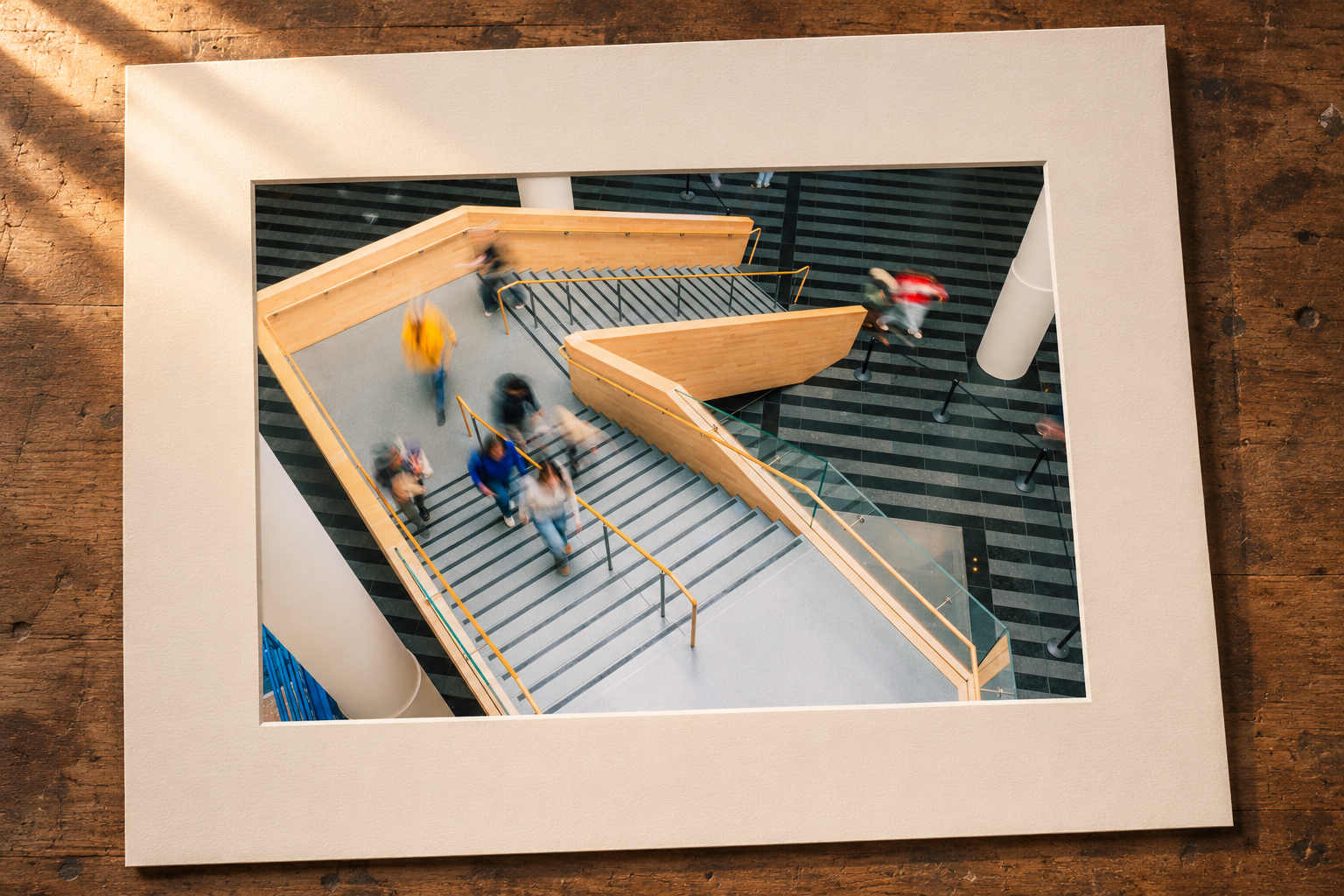
Committed to paper, the photograph takes on weight, texture, and scale. I hold it in my hands and notice how its surface receives the light. The choices made along the way become tangible in this final act: the print.
Act. Observe. Capture. Develop. Print.
Then begin again.
““Exclusion carries consequence. Everything left outside the frame helps determine the meaning of what remains within it.””
