
Precision With Every Click
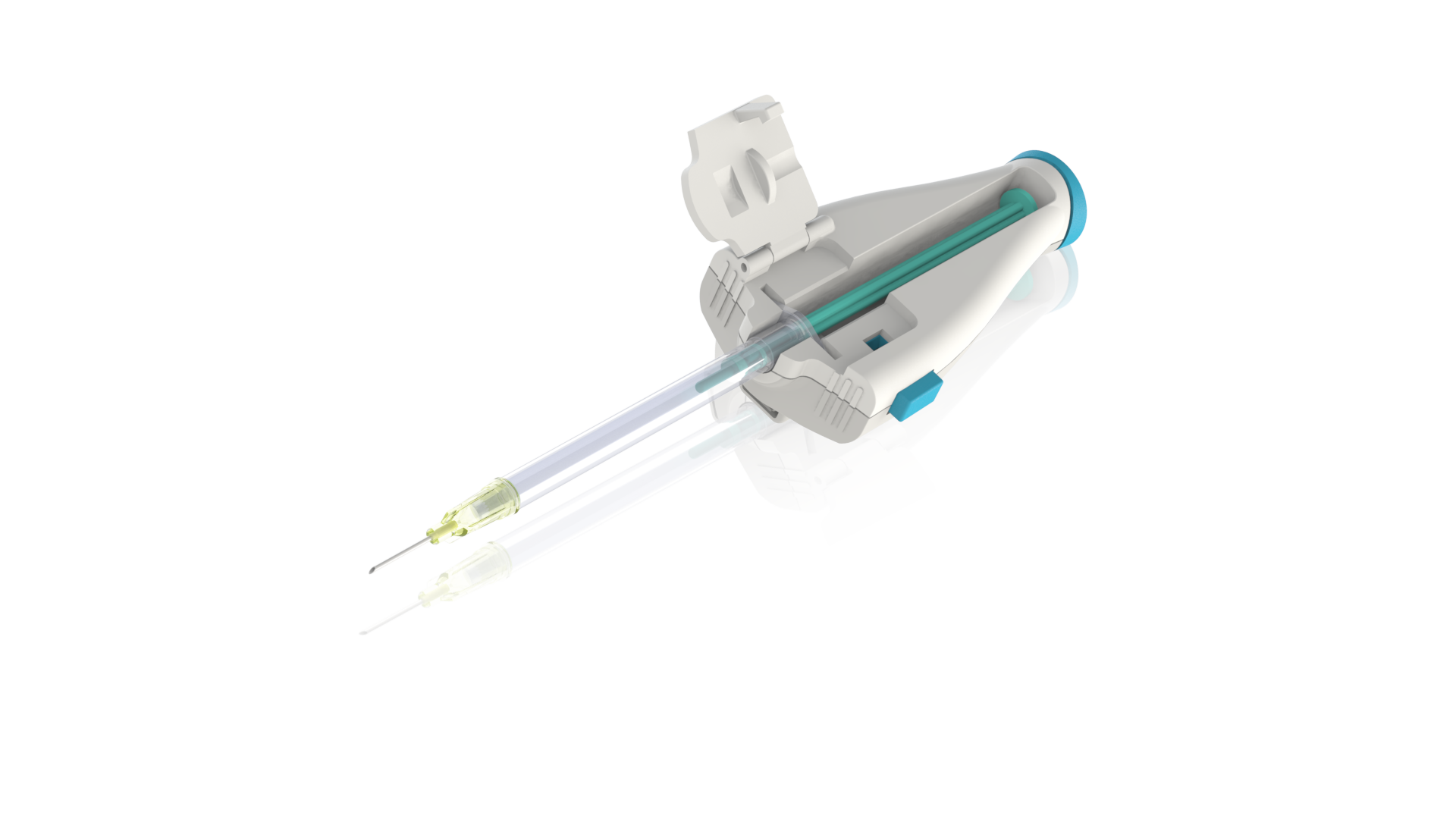
Project: RiteDose Auto-Injector
Focus: Controlled microdermal and subdermal delivery
Some of the most compelling opportunities for innovation appear within familiar actions. A practitioner holds a syringe, positions the needle, and delivers a small quantity of fluid. The process seems simple, yet procedures requiring a series of discrete injections reveal a difficult question: how can each dose be delivered consistently when accuracy depends on estimating movement by hand?
RiteDose began with that question.
The device was developed as a reusable injection-assist tool for procedures requiring carefully controlled fluid delivery across multiple anatomical locations. Its purpose is straightforward: translate each deliberate click into a precise, repeatable dose.
The Challenge Hidden Inside the Syringe
The conventional freehand technique places several demands on the practitioner at once. They must position the syringe, control the needle, monitor the injection site, estimate the plunger’s movement, and keep track of the remaining contents. When a procedure requires multiple injections, small variations can accumulate from one site to the next.
Some practitioners address this problem by preparing multiple syringes, each with an individual dose. Others pause throughout the procedure to examine the syringe barrel and estimate the amount of fluid remaining. Both approaches introduce additional steps, interrupt concentration, and increase procedural complexity.
The unmet need was not simply greater measurement accuracy. The larger opportunity was to improve the relationship between the practitioner, the syringe, and the act of delivery.
Could a familiar manual process become more systematic without becoming more complicated?
Turning Motion Into Measurement
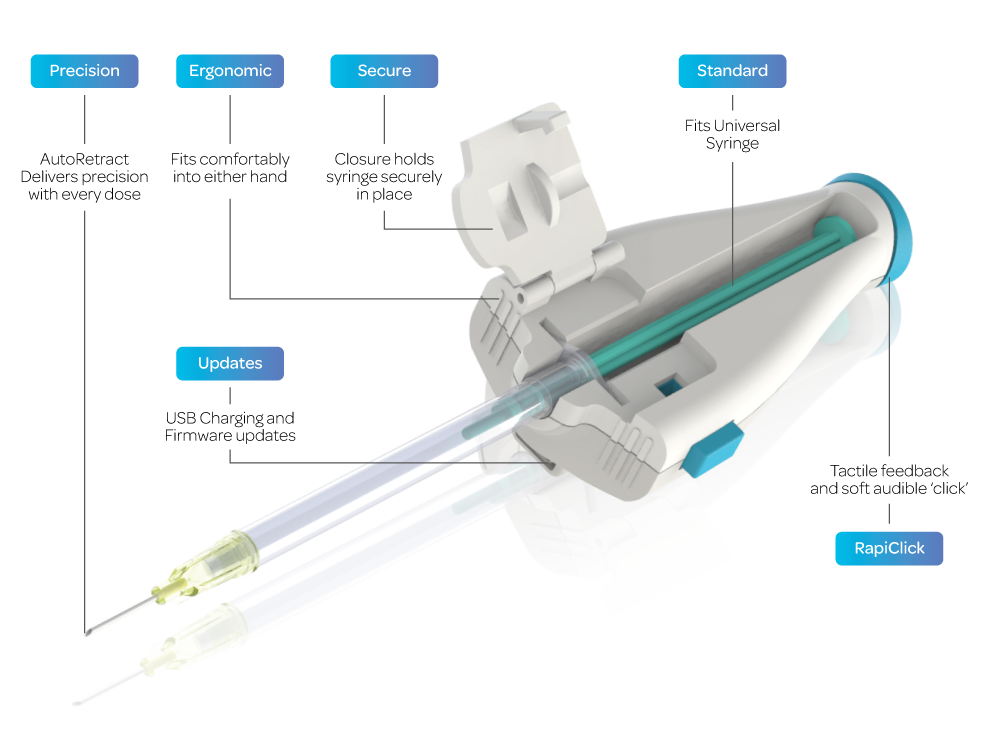
RiteDose complements a conventional disposable syringe with a reusable mechanical accessory. The syringe remains recognizable, while the act of depressing its plunger becomes controlled through a tactile, incremental mechanism.
With each click, the device advances the syringe by a predetermined amount. Rather than asking the practitioner to estimate every dose visually, RiteDose translates a simple physical action into consistent delivery. The mechanism introduces rhythm and repeatability into a process that has traditionally relied on judgment and fine motor control.
This changes the nature of the task. The practitioner can direct more attention toward placement, anatomy, and the patient, while the device helps manage incremental dosing.
Designing for the Hand
Precision alone was not enough. A tool used repeatedly during a procedure should also feel natural, balanced, and intuitive.
RiteDose was shaped around the anatomy and movement of the hand. Its form fits comfortably in either hand, supporting different working positions and practitioner preferences. The tactile click provides an immediate physical signal, allowing the user to feel the completion of each measured delivery without continually shifting attention back to the syringe barrel.
This combination of geometry, mechanical feedback, and ambidextrous use reflects an important principle in my approach to product design: the mechanism and the human experience must be developed together.
A device can be technically accurate and still create friction. It can solve a measurement problem while introducing an ergonomic one. Meaningful innovation requires looking beyond whether a mechanism works; it requires asking how that mechanism participates in the complete procedure.
Precision in Service of Comfort
Patient comfort is influenced by more than the needle itself. It is also shaped by the practitioner’s confidence, the procedure's continuity, and the amount of hesitation or interruption experienced along the way.
By making dose delivery systematic and repeatable, RiteDose is intended to reduce unnecessary pauses and help practitioners move through a series of injection sites more consistently. The result is a process designed to feel more controlled for the practitioner and more considered for the patient.
The device does not replace clinical judgment. It supports it by giving the practitioner a predictable mechanical tool for one of the procedure’s most repetitive and variable actions.
My Approach to Innovation
I am often drawn to moments when a person must compensate for a product's limitations. Estimating the movement of a syringe plunger, preparing multiple syringes, or repeatedly stopping to check fluid levels may seem like accepted parts of a procedure. To me, they are signals.
They suggest that the user is doing work the product could do.
My process begins by observing these points of friction and questioning the assumptions around them. In this case, the challenge was not to reinvent the syringe. It was to preserve what already worked while adding greater control precisely when it was needed.
That distinction shaped RiteDose. The resulting invention is an accessory rather than an entirely new delivery platform. It brings measured advancement, tactile feedback, and ergonomic control to a familiar clinical tool.
Innovation does not always require replacing an established system. Sometimes it means discovering the missing interaction that makes the system work better.
A More Deliberate Delivery Experience
RiteDose transforms a continuous and potentially variable hand movement into a sequence of deliberate, measured actions. Each click becomes both an instruction and a confirmation.
That simplicity is the result of exploring a complex intersection of anatomy, mechanics, workflow, and human behavior. The device reflects my broader belief that good medical design should make precision easier to achieve and complexity easier to manage.
The best tools do more than perform a function. They create confidence through their form, their feedback, and their predictability. RiteDose was designed around that idea: precision should not feel burdensome; it should feel as natural as a click.
